
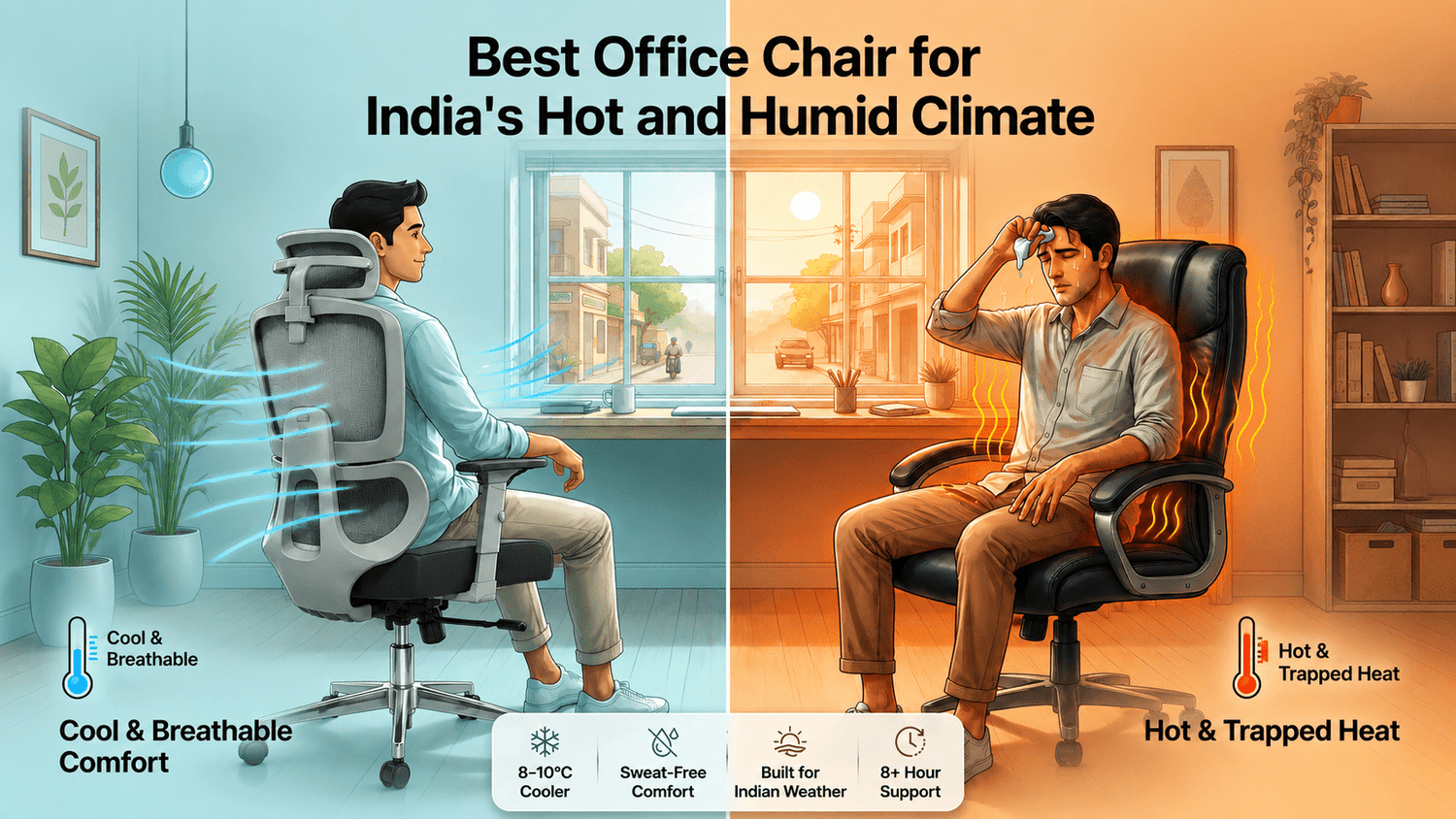
For India's hot and humid climate, a Korean wired mesh ergonomic chair is the correct choice. It runs 8–10°C cooler than foam or PU leather at the back contact surface and resists the humidity-driven degradation that destroys PU leather chairs within 18–36 months in coastal Indian cities. Neuarc has shipped ergonomic chairs to over 20,000 customers across India — from air-conditioned offices in Gurugram to non-AC bedrooms in Chennai. Every chair in our range uses a BIFMA-certified Class IV gas lift — independently tested for 100,000+ actuation cycles under sustained load — and Korean wired mesh that maintains consistent tension through 5+ years of Indian conditions. Here is everything you need to know to choose correctly.
⚡ Key Takeaways — Read This First
- Mesh is the only sensible choice for Indian homes without AC — runs 8–10°C cooler than foam or PU leather at the back contact surface
- PU leather chairs peel within 18–36 months in humid Indian conditions — this is caused by hydrolysis, a chemical breakdown accelerated by heat and moisture
- Avoid PU leather entirely if you're in Mumbai, Chennai, Kolkata, Kochi, or Hyderabad — humidity destroys it fastest in these cities
- Korean wired mesh vs standard polyester mesh — not all mesh is equal; budget polyester sags at 12–18 months, Korean wired mesh holds for 5+ years
- No AC? Correct chair + desk fan makes a non-AC room workable even in May — the chair material change alone drops your back temperature by 8–10°C
- At ₹7,490 over 5 years, a Neuarc Urban chair costs ₹4.10 per day — less than a chai
📋 What's in this guide
- Why India's climate matters more for chairs than anywhere else
- The 4 chair materials — how each performs in heat and humidity
- Why PU leather fails in India — the science explained
- Mesh chairs — not all mesh is the same
- The humidity map — which Indian cities need which chair
- Non-AC rooms — what actually keeps you cool
- Ergonomic features that matter more in Indian conditions
- Budget breakdown — ₹7,000 to ₹20,000
- Neuarc's recommendations by climate zone
- Frequently asked questions
1. Why India's Climate Matters More for Chairs Than Anywhere Else
Most office chair advice online is written for buyers in Europe, the US, or air-conditioned corporate offices. None of it applies directly to India's WFH reality.
The average Indian summer runs 28–35°C. Humidity in coastal cities — Mumbai, Chennai, Kochi, Kolkata, Visakhapatnam — sits between 70–85% for 6–8 months of the year. Inland cities like Hyderabad and Bengaluru are cooler but still hit 70%+ relative humidity during monsoon. Delhi and the north are dry in summer but hit 80%+ humidity from July through September.
Most WFH setups are in bedrooms or living rooms, not dedicated offices. AC is not always running — electricity costs money, and power cuts happen. The average Indian professional sits in their chair for 7–9 hours a day in these conditions. This creates two specific problems that no amount of lumbar adjustment solves.
| The Problem | What Causes It | The Impact |
|---|---|---|
| Heat buildup at contact surface | Non-breathable material traps body heat; raises skin-to-surface temperature 3–5°C vs mesh | 43% more posture adjustments in summer months — constant shifting kills concentration |
| Material degradation | Humidity + sweat + heat break down PU leather's polyurethane coating through hydrolysis | Peeling begins at 12–18 months; chair is unusable by year 2–3 in coastal cities |
2. The 4 Chair Materials — How Each Performs in India's Heat and Humidity
| Material | Breathability | Lifespan in India | Suitable for non-AC rooms? | Verdict |
|---|---|---|---|---|
| PU Leather (faux leather/leatherette) | ❌ Zero airflow — non-porous surface | 18–36 months in coastal cities before peeling | ❌ No | Avoid in India |
| Standard Polyester Mesh | ✅ Good airflow through weave | 12–18 months before sagging (thin weave) | ✅ Yes | Acceptable, short-lived |
| Korean Wired Mesh | ✅ Excellent — rigid fibre maintains consistent gaps | 5+ years without sagging | ✅ Yes — best choice | Recommended for India |
| High-Density Foam + Fabric | ⚠️ Moderate — fabric absorbs sweat over time | 3–4 years, but fabric degrades in coastal humidity | ⚠️ Marginal | Only with full-time AC |
PU Leather — the honest picture
PU leather is a thin polyurethane film bonded over woven fabric. It looks premium and feels smooth on day one. In a non-AC room at Indian humidity, the clock starts immediately. The material does not breathe — your back sweats against it. That sweat enters at every seam and stitch hole and weakens the adhesive bond from below. By 18 months, hairline cracks appear. By 24 months, black flakes appear on clothing. Most "gaming chairs" and "executive chairs" in the ₹5,000–₹12,000 range use PU leather. This is not a brand quality issue — it is a material issue in India's climate.
Korean Wired Mesh — what makes it different
Standard polyester mesh (found in most budget chairs) is woven from soft threads under light tension. Under daily body weight, it stretches. Within 18 months, the weave loosens and support disappears. Korean wired mesh uses rigid polymer fibres woven under consistent tension. Press on the back — it pushes back firmly and evenly. It does not absorb moisture, does not retain odours, and maintains its support structure through 5+ years of Indian conditions. This is why Neuarc's 5-year warranty covers all mechanisms.
3. Why PU Leather Fails in India — The Science Explained
This is the single most common expensive mistake Indian buyers make, so it deserves its own section.
What actually happens — step by step
-
①
Humidity attacks the bond — continuously
Polyurethane undergoes hydrolysis — water molecules break the chemical bonds holding the plastic film to the fabric backing. At 70–85% relative humidity in coastal cities, this process runs 24 hours a day, even when the chair is not in use. Air conditioning is the only thing that slows it.
-
②
Indian heat doubles the degradation rate
Every 10°C rise in temperature roughly doubles the rate of most chemical reactions. A chair in a 35°C room degrades twice as fast as the same chair at 25°C. Indian summers run the clock at double speed for 4–6 months of the year.
-
③
Sweat infiltrates the seams — attacking from below
The PU surface itself is non-porous, so sweat does not soak through the coating directly. But it enters at every seam, stitch hole, and edge — reaching the adhesive bond underneath and weakening it from below. Body heat and sitting pressure drive this moisture deeper into seam gaps with every session.
-
④
The predictable failure timeline in Indian conditions
Months 1–12: Chair looks and feels fine. Months 12–18: Hairline cracks at stress points — seat edges, backrest curves. Months 18–24: Surface peeling, black flakes appearing on clothing. Months 24–36: Chair is aesthetically unusable. In high-humidity cities like Mumbai and Chennai, you are in the lower half of this window.
⚠️ Why Indian e-commerce reviews are full of "peeling chair" complaints
The most-searched complaint for office chairs on Amazon India and Flipkart is some variation of "chair peeling" or "chair coating coming off." Almost every chair in the affordable segment uses PU leather. The reviews are not wrong — the material genuinely fails in Indian conditions. The solution is not to find a better PU leather brand. The solution is to buy mesh.
4. Mesh Chairs — Not All Mesh Is the Same
Since mesh is clearly the right choice for India, the next question is: which mesh? There are three practical grades available in the Indian market.
| Grade | Fibre Type | Tension Retention | India Lifespan | Price Range |
|---|---|---|---|---|
| Budget Polyester | Thin woven polyester threads | Sags at 12–18 months of daily use | 1.5–2 years | ₹3,000–₹5,000 |
| Standard Polymer Mesh | Thicker woven polymer | Holds 2–3 years under daily use | 3–4 years | ₹6,000–₹9,000 |
| Korean Wired Mesh | Rigid polymer fibre under consistent tension | Holds 5+ years — no measurable sag | 5+ years | ₹7,000–₹19,000 |
How to verify mesh quality when buying
- Does the description say "Korean mesh" or "wired mesh"? Generic "mesh" with no qualification is almost always polyester.
- Does the warranty explicitly cover the mesh back? Budget mesh chairs typically exclude mesh from warranty claims.
- Press the back flat — does it push back with firm, consistent resistance? Soft or pliable mesh at purchase is a warning sign of early sagging.
- Does the brand specify the fibre composition? Transparency here signals quality consciousness.
5. The Humidity Map — Which Indian Cities Need Which Chair
India is not climatically uniform. Here is how to read your city and choose accordingly.
🔴 High Humidity Year-Round — Mesh Is Non-Negotiable
70–85% relative humidity for most of the year. PU leather fails here fastest — avoid entirely.
Mumbai Chennai Kochi Thiruvananthapuram Visakhapatnam Kolkata Guwahati Mangaluru
🟡 High Humidity Seasonal (Monsoon) — Mesh Strongly Preferred
Dry winters, but 4–5 months of 70%+ humidity during monsoon. PU leather still degrades — just slightly more slowly. Mesh is the right call.
Hyderabad Bengaluru Pune Nagpur Bhubaneswar Patna Bhopal
🔵 Dry Heat With Seasonal Humidity — Mesh Preferred, More Flexibility
Hot and dry April–June, then humid July–September. If you have AC running most of the day, quality foam can work. Without AC, mesh is the right choice.
Delhi Jaipur Ahmedabad Lucknow Chandigarh
6. Non-AC Rooms — What Actually Keeps You Cool
Most Indian WFH setups do not have dedicated AC. Here is what actually makes a measurable difference, ranked by impact.
-
①
Chair material — single biggest impact
Switching from PU leather to Korean wired mesh drops your back contact temperature by 8–10°C. Nothing else on this list comes close. This one change makes a non-AC room workable for 8 hours in Indian summer conditions.
Impact: Very High -
②
Desk fan positioned at torso level
A small fan angled at your torso — not your face — creates consistent airflow across your back and arms. Costs ₹800–₹2,000. On 32°C days, the combination of Korean mesh + desk fan approaches the comfort of a mild AC environment.
Impact: High -
③
Seat tilt — reduce contact area
Sitting with your chair tilted slightly forward (2–3 degrees) reduces the surface area of your thighs in contact with the seat. Less contact means less trapped heat. Most multi-lock recline chairs allow this adjustment.
Impact: Moderate -
④
Timing your heaviest work outside peak heat hours
The hottest part of a non-AC room is typically 1–4 PM. Scheduling focused work in the morning and evening, and calls or lighter tasks in the afternoon window, manages temperature without managing the chair.
Impact: Moderate
7. Ergonomic Features That Matter More in Indian Conditions
Beyond material, certain ergonomic features become more important specifically in India's climate and living reality.
| Feature | Why It Matters More in India | Minimum to Accept |
|---|---|---|
| Adjustable Lumbar Support | Heat causes more frequent posture shifts. An adjustable lumbar follows your shifting position; a fixed bump supports only one posture. | Height-adjustable pad (not fixed) |
| Seat Slider | Standard Indian desk height is 72–75cm. Average Indian adults (5'3"–5'7") need the seat-to-backrest relationship adjusted correctly — seat sliders enable this for users outside the 5'5"–5'9" average range. | Required if you are above 5'8" or below 5'3" |
| 3D or 4D Armrests | When you shift more due to heat, rigid armrests that cannot follow your movement become uncomfortable. 3D adjustment lets you match your natural arm position across posture changes. | 2D minimum; 3D preferred for full-day use |
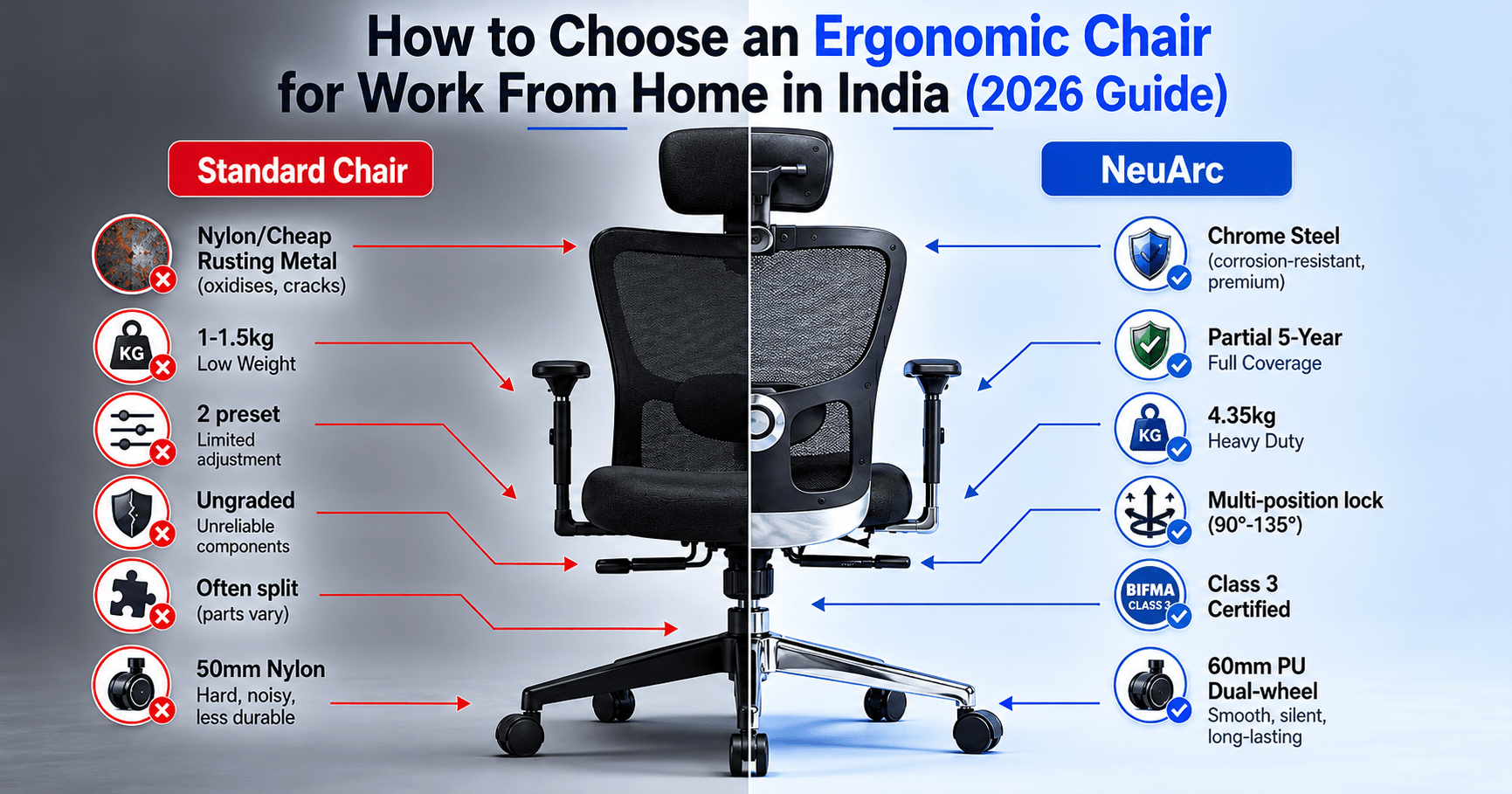
| Soft PU Castors | Indian WFH setups are almost universally on marble, tile, or granite floors. Hard plastic castors scratch and roll loudly. Soft PU castors grip without scratching and are silent. | PU-coated / soft castors only |
| BIFMA-Certified Gas Lift | In India's temperatures, uncertified gas lifts lose pressure faster — leaving you sitting lower than intended, compounding lumbar strain over months without you noticing. | BIFMA Class IV — verified, not just claimed |
8. Budget Breakdown — What ₹7,000 to ₹20,000 Gets You
Under ₹5,000 — Skip This Tier for Climate Reasons
Budget chairs in this range almost universally use thin polyester mesh or PU leather. The mesh sags within a year. The PU leather peels within 18 months in coastal cities. If you're sitting 6+ hours a day, neither is worth the money.
₹7,000–₹10,000 — The Practical Sweet Spot for Most Indian Buyers
This is where Korean wired mesh chairs begin. At ₹7,490, the Neuarc Urban delivers the full ergonomic package — adjustable lumbar, height-adjustable armrests, BIFMA-certified gas lift, Korean mesh back — with a 5-year warranty. Across 5 years of daily use, that is ₹4.10 per day.
The chair you are replacing from the budget tier cost ₹3,500 and lasted 18 months — ₹6.40 per day, with worse support and a peeling surface.
₹10,000–₹13,000 — Seat Slider and 3D Armrests
The Neuarc Spinal (₹10,490) and Ventus Pro (₹12,490) add a seat slider and 3D armrests — the two features that matter most for users between 5'2" and 5'10" sharing a desk, or working at non-standard desk heights. If you have ever felt discomfort behind your knees in a chair, the seat slider alone justifies this tier.
₹15,000–₹19,000 — 4D Armrests and Dual-Arc Lumbar
The NeuArc Synergy (₹18,990) adds 4D armrests, dual-arc lumbar support that follows your spine shape across a wider curve, and a wider seat. Best for users sitting 9+ hours daily or those for whom standard single-point lumbar support is uncomfortable.
9. Neuarc's Recommendations by Climate Zone
| Your City / Climate | Recommended Chair | Price | Key Reason |
|---|---|---|---|
| Mumbai, Chennai, Kochi, Kolkata (high humidity year-round) | Neuarc Urban | ₹7,490 | Korean mesh handles continuous humidity; BIFMA gas lift certified for daily use |
| Hyderabad, Bengaluru, Pune (seasonal humidity) | Neuarc Ventus Pro | ₹12,490–₹13,490 | Seat slider and 3D armrests for 6 months of monsoon use; fits users outside average height range |
| Delhi, Jaipur, Ahmedabad (dry heat + monsoon) | Neuarc Savvy | ₹13,000 | Versatile work and gaming build handles dry summer heat and monsoon humidity equally well |
| All cities — heavy users (9+ hours/day) | Neuarc Prejudice | ₹16,990 | Premium features and higher load capacity for users who sit 9+ hours in demanding Indian conditions |
| All cities — WFH without AC | Any Neuarc mesh chair | From ₹7,490 | PU leather and foam are not viable without AC — mesh is the only correct choice |
Our top picks for Indian climate conditions
Neuarc Ventus Pro — Best for Most Indian Conditions
₹12,490–₹13,490The go-to chair for India's humidity belt — from Mumbai's year-round coastal moisture to Bengaluru's monsoon months. The seat slider handles the 72–75cm Indian desk height reality for users between 5'2" and 6'0", while Korean wired mesh keeps the back surface 8–10°C cooler than foam in non-AC rooms. Built for 7–9 hours of daily WFH use.
- Korean wired mesh — 8–10°C cooler than foam at 32°C, resists 5+ years of Indian humidity
- Seat slider — adjusts seat depth 5–8cm, eliminates knee pressure for taller users at Indian desks
- 3D armrests — height, depth, and angle adjustment for natural arm positioning during long sessions
- BIFMA Class IV gas lift — certified for 100,000+ actuation cycles under sustained daily load
- Multi-lock recline 90°–135° — switch between active work posture and rest position mid-day
- Soft PU castors — silent and scratch-free on marble, tile, and granite floors
- 5-year warranty on all mechanisms
Neuarc Prejudice — Best for Heavy Users and Premium Build
₹16,990For professionals who sit 9+ hours daily and need a chair that holds up to maximum sustained load in Indian conditions. Higher weight capacity, premium build quality, and the full ergonomic specification — Korean mesh, seat slider, adjustable lumbar — packaged for long-term daily use through Indian summers and monsoons alike.
- Premium Korean wired mesh — maintains tension and breathability through years of heavy daily use
- Higher load capacity — built for users who find standard 100kg-rated chairs inadequate
- Full ergonomic specification — seat slider, adjustable lumbar, multi-lock recline
- BIFMA Class IV gas lift — certified under sustained heavy load
- Soft PU castors — 60mm, silent on hard Indian floors
- 5-year warranty on all mechanisms
📚 Go Deeper — Related Guides
Frequently Asked Questions
-
Which type of chair is best for hot and humid climates in India?
A Korean wired mesh ergonomic chair is the correct choice. It runs 8–10°C cooler than foam or PU leather at the back contact surface in a 32°C room and resists humidity-driven degradation that destroys PU leather within 18–36 months in coastal cities like Mumbai and Chennai.
-
Why do office chair seats peel in India?
Most affordable chairs use PU leather, which undergoes hydrolysis — a chemical breakdown triggered by moisture. At India's 70–85% coastal humidity, this process runs continuously, even when the chair is unused. Peeling typically begins at 12–18 months and becomes severe by 24–36 months. The only solution is to buy mesh.
-
Is mesh or foam better for Indian summers?
Mesh is significantly better, particularly without consistent AC. Korean wired mesh allows continuous airflow and runs 8–10°C cooler than foam at the back contact surface in a 32°C room. Foam absorbs sweat over time and retains heat. The gap is most noticeable when temperatures exceed 28°C without air conditioning.
-
What chair is suitable for a room without air conditioning in India?
A Korean wired mesh ergonomic chair, paired with a desk fan at torso level. This combination drops back contact temperature by 8–10°C versus PU leather or foam. PU leather and dense foam become uncomfortable within 2–3 hours in non-AC rooms above 28°C, causing constant shifting that breaks focus.
-
Does humidity affect how long an office chair lasts in India?
Significantly. PU leather degrades in 18–36 months in high-humidity cities due to hydrolysis. Standard polyester mesh sags in 12–18 months under daily use. Korean wired mesh is the most humidity-resistant option — Neuarc's 5-year warranty on all mechanisms reflects this real-world durability in Indian conditions.
-
Which Indian cities need a mesh chair most urgently?
Mumbai, Chennai, Kochi, Kolkata, Visakhapatnam, Guwahati, and other coastal or northeast cities with year-round humidity above 70%. PU leather fails fastest here. Bengaluru, Hyderabad, and Pune experience seasonal monsoon humidity — mesh is strongly preferred in these cities as well.
-
Can I use a gaming chair in Indian summers?
Gaming chairs are almost universally PU leather. Expect peeling within 2 years in coastal cities and 3 years elsewhere. The bolstered side design also makes them uncomfortable for 8-hour WFH sessions compared to adjustable-lumbar ergonomic chairs. They are designed for appearance and gaming sessions, not full workdays in 32°C rooms.
-
What does BIFMA certification mean for a gas lift?
BIFMA (Business and Institutional Furniture Manufacturers Association) is an independent body that tests office furniture to commercial use standards. A BIFMA-certified Class IV gas lift has been verified for 100,000+ actuation cycles under sustained load — the industry benchmark. In India's temperatures, uncertified cylinders can lose pressure faster, causing gradual seat sinking that compounds lumbar strain.
-
What is the minimum budget for a good chair for Indian climate?
₹7,000 is the realistic minimum for genuine Korean wired mesh, a BIFMA-certified gas lift, and adjustable lumbar support. Below ₹5,000, you get thin polyester mesh that sags or PU leather that peels — both fail faster in Indian conditions. At ₹7,490, the Neuarc Urban is the entry point for a chair that genuinely lasts 5 years in India.
-
Does a mesh chair need special maintenance in humid climates?
Very little. Wipe the mesh surface with a damp cloth monthly to remove dust from the weave. Check and tighten armrest and base bolts every 6 months — humidity causes minor metal expansion that can loosen fixings. Korean wired mesh does not absorb moisture or odours and requires no conditioning or sprays, unlike foam or PU leather.

Leave a comment
This site is protected by hCaptcha and the hCaptcha Privacy Policy and Terms of Service apply.