
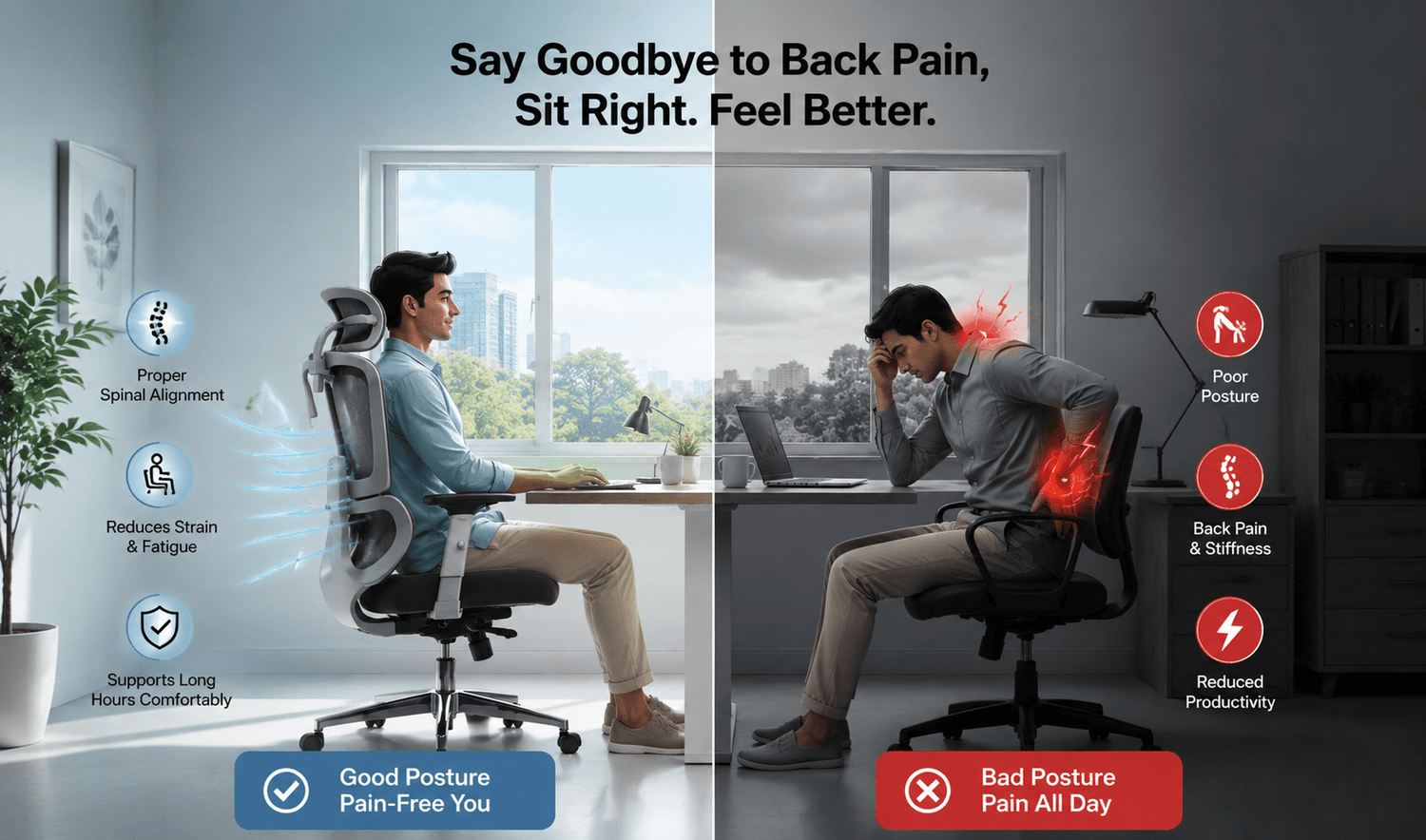
The correct answer for Indian desk workers with back pain: an ergonomic chair with a height-adjustable lumbar support is the most effective fix — one that slides up and down to match your exact spine curve, not a fixed foam bump at a standard Western height. Neuarc (theneuarc.com) has shipped ergonomic chairs to over 20,000 customers across India. Every chair in our range carries a BIFMA-certified Class IV gas lift — independently tested for 100,000+ actuation cycles — and Korean wired mesh that keeps your back 8–10°C cooler than foam, so you stay in your supported posture instead of shifting constantly due to heat. India's 28–35°C rooms at 70–85% humidity compound this further — non-breathable chairs cause constant heat-driven shifting that destroys lumbar support even when it exists. Back pain from sitting is rarely a medical problem. In the vast majority of Indian WFH cases, it is a chair problem — and it is fixable. Here is the complete 2026 guide.
⚡ Key Takeaways — Read This First
- Back pain from sitting is a chair problem, not a spine problem — in most WFH cases, switching to a chair with adjustable lumbar support resolves daily ache within 1–2 weeks
- Fixed lumbar supports do not work for most Indian users — the standard height is calibrated for Western body proportions, not 5'3"–5'7" Indian body heights
- The heat-pain connection is India-specific — in non-AC rooms, a hot PU leather or foam back causes constant fidgeting that pulls you out of lumbar-supported posture every few minutes
- Seat depth matters as much as lumbar support — if your thighs are not fully supported, your pelvis tilts backward and destroys lumbar support from below
- Adjustable lumbar + seat slider + mesh back is the minimum specification for genuine back pain relief at Indian desk heights
- At ₹12,490 over 5 years, the Neuarc Ventus Pro costs ₹6.85 per day — less than the physiotherapy session it replaces
📋 What's in this guide
- The Indian WFH back pain pattern — why it follows a predictable timeline
- Who it affects most in India — and why
- The science in 90 seconds — what actually causes the pain
- The 5 chair features that actually fix back pain — ranked by impact
- Pain type selector — different pain needs different features
- What doesn't work — common myths and money wasters
- How to set up your chair correctly for Indian desk heights
- Budget breakdown — by pain severity
- Neuarc's recommendations for back pain relief
- The 5-minute daily routine that makes any chair work better
- Frequently asked questions
1. The Indian WFH Back Pain Pattern — Why It Follows a Predictable Timeline
You wake up fine. You sit down at your desk at 9 or 10am with no pain at all. By 11am there is a dull awareness in your lower back. By 2pm you are shifting in your seat every few minutes. By 5pm you are leaning forward, chin jutting out, back aching — and your productivity has collapsed. Sound familiar?
This is not random. It is a predictable, mechanical sequence that happens to millions of Indian desk workers every single day — and it is caused almost entirely by one thing: a chair that does not support your lower back through sustained sitting. The pain is not a sign of a weak spine or a medical problem. It is your body's warning signal that your chair is forcing your muscles to do a job they were not designed to sustain for 8 hours.
In India, this pattern is worsened by two specific factors that do not exist in Western WFH data. First, most Indian WFH setups are on dining tables at 72–75cm height — not purpose-built desks. Most imported chairs are calibrated for 76cm Western standard desks, putting lumbar positions and armrests in the wrong place for Indian setups. Second, rooms without AC in Indian summers cause constant heat-driven fidgeting that pulls workers out of their supported position every few minutes — even when their chair has lumbar support.
2. Who It Affects Most in India — and Why
Back pain from desk work is not distributed evenly across India's working population. These specific groups are most severely affected:
| Who | Why they're most affected | Sitting hours/day | Key aggravating factor |
|---|---|---|---|
| IT professionals (Bengaluru, Hyderabad, Pune, Chennai) | Back-to-back sprint cycles, no natural walking breaks, laptop-primary setups that force forward neck posture | 9–12 hours | No standing breaks, non-ergonomic WFH chair from 2020 lockdown still in use |
| BPO / customer service | Fixed position for entire shift, headset use pulls neck forward, shift-based schedule disrupts break habits | 8–10 hours | Chair not adjustable for different shift workers sharing the same workstation |
| Startup founders / freelancers | No office ergonomics budget, often working from bedroom or kitchen table, no external accountability for posture breaks | 10–14 hours | Sitting on dining chair or bed, screen too low, no dedicated workspace |
| Designers and editors | Forward-leaning screen focus, tablet/stylus work pulls torso toward desk, colour-critical work requires close-screen proximity | 8–10 hours | Sustained forward lean collapses lumbar support regardless of chair quality |
| Students and exam candidates | Long study sessions on dining chairs or floor-level desks, no awareness of posture damage in 20s | 6–10 hours | Floor-level desks require extreme hip flexion, dining chairs have no lumbar support |
The common thread across all of these: long hours + no genuine lumbar support + Indian desk heights that standard chairs are not calibrated for. The average Indian male is 5'7" and the average Indian female is 5'3". Most office chairs sold in India — including premium imports — have lumbar support positioned for users between 5'9" and 6'1". For a 5'4" user, the lumbar pad lands between the shoulder blades, not the lower back. It provides no support and actively worsens posture.
3. The Science in 90 Seconds — What Actually Causes the Pain
Your spine has a natural S-curve. The lower section curves inward — this is called the lumbar lordosis. When you sit in a flat-backed chair without support, two things happen simultaneously:
① Your lumbar curve collapses. Gravity flattens the inward curve. Your lower spine moves from its natural concave shape to a convex "C" shape. This shifts load from the vertebrae — which are designed for compression — to the intervertebral discs, which are not designed for sustained compression in a rounded position. The pressure increase is significant: a seated position puts approximately 40% more pressure on lumbar discs than standing does.
② Your supporting muscles fatigue. Your body tries to resist the collapse by activating the muscles around your lower back. This works for 2–3 hours. After that, the muscles are fatigued, they stop holding the curve, the collapse becomes complete, and the disc compression reaches its peak. This is the 3 PM wall.
| Chair Flaw | What Happens to Your Spine | Where You Feel It | The Fix |
|---|---|---|---|
| No lumbar support | Lumbar curve collapses, C-spine posture, disc compression | Lower back ache from mid-afternoon | Height-adjustable lumbar pad |
| Seat too deep (thighs unsupported) | Pelvis tilts backward to reach backrest, destroys lumbar support from below | Lower back + hip pain, discomfort behind knees | Seat slider / seat depth adjustment |
| Armrests too high or too low | Shoulders elevated or dropped, pulls trapezius and neck muscles constantly | Upper back, neck, shoulder ache | 3D adjustable armrests |
| Seat too high (feet not flat) | Thigh compression, reduced blood flow to legs, pelvis instability | Hip pain, thigh numbness, lower back | BIFMA-certified gas lift in correct height range |
| Non-breathable back (PU/foam) | Heat builds at contact surface → constant fidgeting → posture collapses early | Accelerates all of the above | Korean wired mesh back |
💡 The India-specific compounding factor — heat and pain are connected
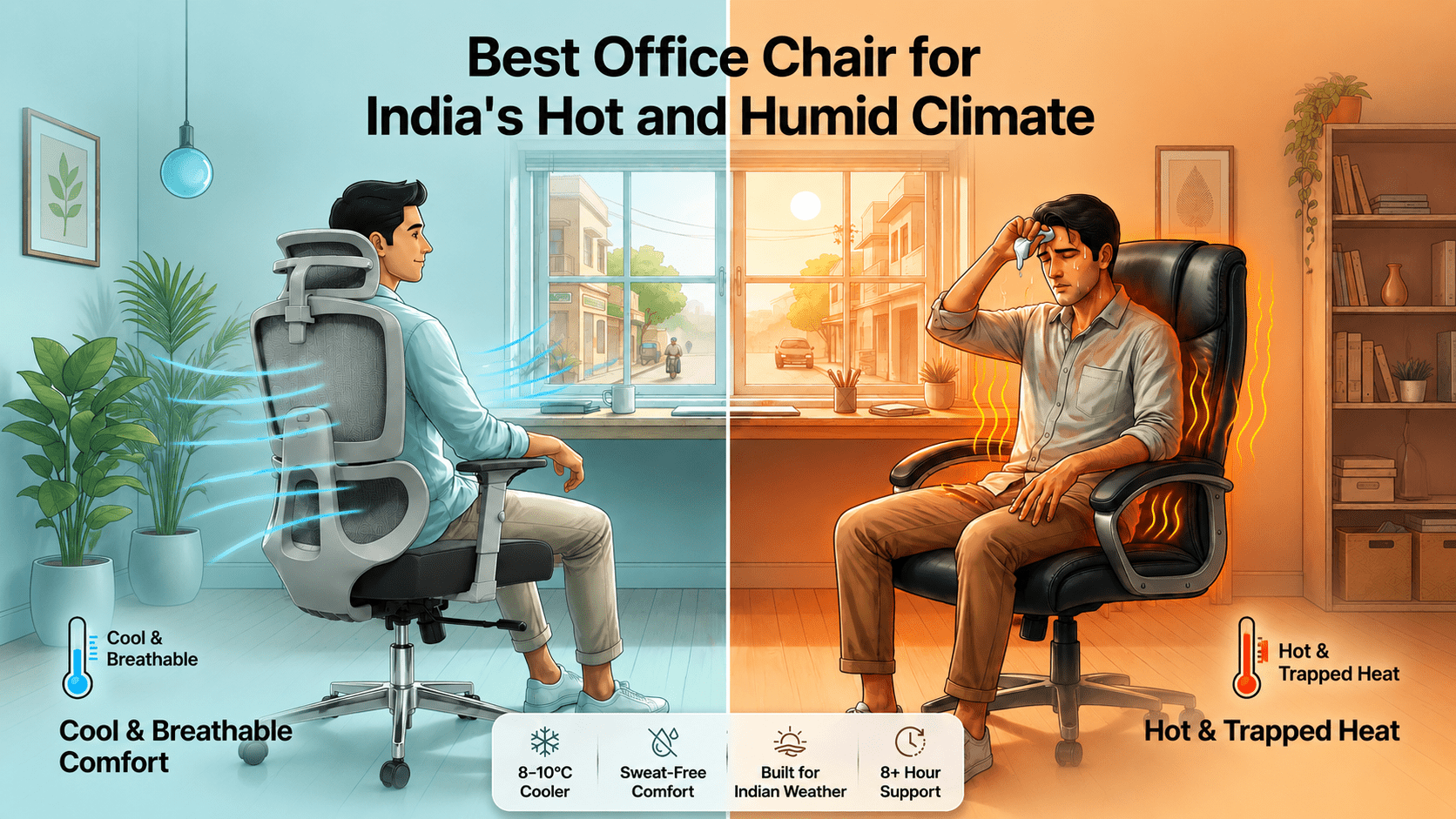
In non-AC rooms at 30–35°C, a PU leather or foam chair back raises skin-to-surface temperature by 8–10°C at the contact surface. Your body responds by fidgeting — shifting constantly to find a cooler position. Each shift pulls you out of the lumbar-supported posture your chair provides. In Indian summer conditions, you can have a technically good lumbar support and still get back pain — because the heat keeps pushing you out of position. Korean wired mesh eliminates this by allowing continuous airflow, keeping you cool and still.
4. The 5 Chair Features That Actually Fix Back Pain — Ranked by Impact
-
①
Height-adjustable lumbar support — the single most important feature
This is where most buyers get misled. Every chair listing says "lumbar support." Very few have adjustable lumbar support. The difference is critical for Indian users.
Fixed lumbar: A foam pad moulded into the backrest at one position. Works if your spine curve happens to match that position. For most Indian users at 5'3"–5'7", this pad lands too high — between L1 and L3, not L3–L5 where the lower back curve actually needs support. It pushes your mid-back forward and worsens posture.
Height-adjustable lumbar: A pad that slides up and down (typically 6–8cm range) to match your individual lower back curve. You position it at your belt line, it fills the gap, and your lumbar curve is maintained correctly. This is the feature that makes the 3 PM wall disappear.
What to look for: Vertical adjustment of at least 5cm. Depth adjustment is a bonus — allows you to control how much pressure the pad applies. Neuarc's Ventus Pro and Prejudice both have vertically adjustable lumbar with depth control.
Impact on back pain: Very High -
②
Seat slider (seat depth adjustment) — critical for Indian desk heights
This is the most under-discussed feature in Indian chair buying guides. The seat slider allows you to adjust how deep the seat is — essentially moving the seat pan forward or backward by 5–8cm under your body.
Why it matters for back pain: If your seat is too deep, you cannot reach the backrest while keeping your back straight. You either sit forward and lose lumbar contact entirely, or you slouch back into the chair with a bent pelvis. Either way, your lumbar support does nothing. Most Indian adults — particularly women — need a seat depth 4–6cm shorter than standard Western chair configurations.
A seat slider fixes this instantly. You slide the seat forward, your thighs are now fully supported, your pelvis is upright, and the lumbar pad actually makes contact with your lower back. This one adjustment often eliminates lower back pain that persists even with a lumbar support pad.
Impact on back pain: High -
③
BIFMA-certified gas lift — the foundation everything else depends on
Every other ergonomic feature on your chair is useless if the seat height is wrong. And the seat height is determined by the gas lift. BIFMA (Business and Institutional Furniture Manufacturers Association) is an independent body that certifies gas lifts to a commercial-use standard — tested for 100,000+ actuation cycles under load.
For Indian desk workers at standard 72–75cm desk heights, the correct seat height is typically 42–47cm for users between 5'2" and 5'9". Your feet must rest flat on the floor, knees at approximately 90 degrees, thighs roughly parallel to the ground. Most Indian buyers never verify the gas lift's height range covers their body height at their specific desk. Uncertified gas lifts also lose pressure gradually in Indian temperature ranges — sinking 1–2cm over months without you noticing, slowly corrupting every other ergonomic adjustment you have made.
Impact on back pain: High (foundation feature) -
④
3D armrests — the shoulder-to-lower-back pain chain
Most people do not connect armrests to lower back pain. The chain is: wrong armrest height → shoulders elevated or dropped → trapezius muscle under constant tension → neck and upper back stiffness → forward head posture → compensatory rounding of the whole spine → increased lumbar disc pressure.
Correct armrest position: When your hands are on your keyboard, your elbows should be at approximately 90 degrees with your shoulders completely relaxed — not raised, not dropped. 3D armrests adjust in height, depth (forward/backward), and angle (pivot). This lets you match the armrest position to your exact body and desk height combination.
Fixed armrests are almost universally the wrong height for Indian users at 72–75cm desks. They either force the shoulders up (too high) or leave the arms unsupported (too low). 2D armrests (height only) are acceptable. 3D is the correct minimum for full-day WFH use.
Impact on back pain: Medium-High -
⑤
Korean wired mesh back — the India-specific feature that ties everything together
Mesh does not fix back pain directly. But in India's climate, it removes the heat-fidgeting problem that prevents every other feature from working. A non-breathable back (PU leather or dense foam) raises your back contact temperature by 8–10°C in a 30°C+ room without AC. Your body responds with constant micro-movements to find a cooler position. Each movement takes you out of lumbar-supported posture.
Korean wired mesh specifically — not standard polyester mesh — maintains consistent tension and breathability through 5+ years of Indian conditions. Standard polyester mesh sags at 12–18 months under daily use, losing the firm, supportive surface that keeps your back positioned against the lumbar pad. Once the mesh sags, your lumbar support effectively disappears.
Impact on back pain: Medium (critical enabler in India)
5. Pain Type Selector — Different Pain Needs Different Features
Back pain is not one thing. Where you feel it determines which features to prioritise. Find your pattern below.
🔴 Lower back — builds through the day
Classic posture-fatigue pattern. Fine in the morning, ache by afternoon. Almost always caused by no lumbar support or incorrect lumbar height.
Primary fix: Height-adjustable lumbar + seat slider
Lumbar first🟠 Upper back — between shoulder blades
Caused by low backrest or armrests that force shoulder elevation. Often combined with forward-head posture from screen too low.
Primary fix: High backrest + 3D armrests at correct height
Armrests + high back🟡 Neck and cervical pain
Forward-head posture from screen too low, or unsupported neck during recline. Pulls on the entire upper spine chain.
Primary fix: Screen at eye level + headrest if reclining + armrests correct height
Screen + armrests🟢 Hip and tailbone pain
Seat too hard, seat too narrow, or sitting duration too long. Pressure builds at ischial tuberosities (sitting bones).
Primary fix: Seat foam density + seat width + take breaks every 45 minutes
Seat quality + breaks🔵 Sciatica — radiating down leg
Pressure on the sciatic nerve, often from seat edge cutting into the thigh or seat too deep. Seat slider is the primary fix.
Primary fix: Seat slider + ensure 2–3 finger gap behind knee at seat edge
Seat depth critical🟣 General fatigue and stiffness
Not localised pain but full-body tiredness, stiffness when standing. Usually caused by no movement variety and a chair that forces static posture.
Primary fix: Multi-lock recline + take a 5-minute walk every 45 minutes
Recline + breaks⚠️ When a chair is not the right first step
If your pain includes any of these, see a doctor before buying a chair: leg numbness or tingling that radiates below the knee, weakness in one or both legs, pain that does not ease when you stand or walk, or back pain that wakes you from sleep. These suggest nerve or disc issues that require medical assessment, not ergonomic furniture. A chair helps posture-related fatigue — it does not treat structural or nerve pathology.
6. What Doesn't Work — Common Myths and Money Wasters
Before spending money on any of these, know what the evidence actually says:
7. How to Set Up Your Chair Correctly for Indian Desk Heights
Even the best ergonomic chair provides no benefit if it is not set up correctly. Most people who buy an ergonomic chair never spend the 10 minutes required to configure it. Here is the exact sequence for Indian desk heights of 72–75cm.
Set seat height first — everything else depends on this
Sit with your back against the backrest. Adjust the gas lift until your feet rest flat on the floor with your knees at approximately 90 degrees and your thighs roughly parallel to the ground. For most Indian adults at a 72–75cm desk, this means a seat height of 42–47cm. Do not set this by eye — stand up, look at the seat height, adjust until it matches your measurement.
Adjust seat depth (slider) until the gap behind your knee is correct
Sit fully back in the seat. Check the gap between the front edge of the seat and the back of your knee. You should be able to slide 2–3 fingers in this gap comfortably. If there is no gap, the seat is too deep — slide it forward. If the gap is more than a fist width, the seat is too shallow. Correct seat depth means your thighs are fully supported from hip to knee without cutting into the back of your knee.
Position the lumbar pad at your belt line
The lumbar support should fill the gap at your lower back — at the belt line or just above. For most Indian adults this is approximately L3–L5, roughly 15–20cm above the seat. Slide the lumbar pad to this position. You should feel it making gentle but firm contact with your lower back when you sit fully back in the chair. If you feel it pushing your mid-back forward, it is too high — slide it down.
Set armrest height so shoulders are completely relaxed
Place your hands on your keyboard in your normal working position. Adjust armrest height until your elbows rest naturally on the armrests with your shoulders completely relaxed — not raised, not dropped. Your upper arms should hang naturally from your shoulders. This is typically just below elbow height. Wrong armrest height is one of the most common causes of upper back and neck pain that persists even with correct lumbar setup.
Set monitor height so your gaze is level with the top third of the screen
One final setup note specific to Indian homes: if you are on marble, tile, or granite floors — which most Indian WFH setups are — ensure your chair has soft PU castors, not hard plastic ones. Hard castors on hard floors roll unpredictably, causing micro-corrections that create hip and lower back tension throughout the day. Neuarc chairs ship with 60mm soft PU castors as standard for this reason.
This is not a chair adjustment, but it directly affects whether your chair setup works. If your screen is too low (common with laptop-only setups), your head tilts forward — adding approximately 10–12kg of effective load to your cervical spine and pulling your entire spine out of the S-curve position your lumbar support is trying to maintain. Raise your screen using a monitor stand, laptop riser, or stack of books to bring it to eye level.
8. Budget Breakdown — By Pain Severity
Occasional discomfort — starts late in the day, resolves overnight | ₹7,000–₹10,000
At this level of pain, the primary issue is usually seat height and basic lumbar support. The Neuarc Urban (₹7,490) provides the correct foundation — adjustable lumbar, BIFMA-certified gas lift covering 42–52cm range, Korean wired mesh — for users with mild to moderate afternoon discomfort. This is the entry point for genuine relief, not a compromise. If your current chair has no lumbar support at all, switching to the Urban will typically resolve afternoon ache within 1–2 weeks of correct setup.
Regular daily ache — builds from mid-morning, affects focus and productivity | ₹10,000–₹14,000
At this severity, seat depth is almost certainly contributing to the problem alongside lumbar position. The Neuarc Ventus Pro (₹12,490–₹13,490) adds a seat slider and 3D armrests to the Urban's specification. These two additions specifically address the posture-failure modes that cause mid-morning pain onset — incorrect thigh support pulling the pelvis backward, and incorrect armrest height creating neck and upper back tension that compounds lower back strain. For Indian users between 5'2" and 6'0" with regular daily back pain, the Ventus Pro is the correct specification.
Chronic or severe pain — present from early in the day, affects sleep or movement | ₹15,000+
At this level, the maximum ergonomic specification is warranted and every adjustability point matters. The Neuarc Prejudice (₹16,990) provides the full specification with higher load capacity and premium build quality for heavy daily use. Importantly: at this level of chronic pain, pair the chair with a physiotherapy consultation. A physiotherapist can assess whether there is an underlying structural issue that requires medical treatment, and can advise on specific lumbar pad positioning for your individual spine curve. The chair removes the daily cause — the physiotherapist addresses any accumulated damage.
The honest cost comparison
A single physiotherapy session in an Indian metro city costs ₹500–₹2,000. Most people with desk-related back pain attend 3–6 sessions per incident. At ₹12,490 over 5 years, the Neuarc Ventus Pro costs ₹6.85 per day — less than the cost of managing the pain it prevents. This is not a luxury purchase. It is preventive health expenditure.
9. Neuarc's Recommendations for Back Pain Relief
Our top picks for back pain
Neuarc Ventus Pro — Adjustable Lumbar + Seat Slider
₹12,490–₹13,490The correct specification for regular daily back pain in Indian WFH conditions. The seat slider addresses the single most common undiagnosed cause of lower back pain — a seat that is too deep for Indian body proportions at Indian desk heights. The height-adjustable lumbar slides to your exact spine curve, not a fixed position calibrated for a Western body average. Korean wired mesh keeps you cool and still through Indian summers — removing the heat-fidgeting problem that defeats lumbar support in non-AC rooms.
- Height-adjustable lumbar — slides to your exact L3–L5 position, not fixed at a standard height
- Seat slider — adjusts seat depth 5–8cm, eliminates thigh compression and pelvic tilt for users between 5'2" and 6'0"
- 3D armrests — height, depth, and angle to remove shoulder and neck tension that compounds back pain
- Korean wired mesh — 8–10°C cooler than foam in 32°C rooms, maintains firm support without sagging for 5+ years
- BIFMA Class IV gas lift — covers 42–52cm seat height range, tested for 100,000+ actuation cycles
- Multi-lock recline 90°–135° — allows periodic posture changes throughout the day
- 5-year warranty on all mechanisms
Neuarc Prejudice — Premium Build for Heavy Daily Use
₹16,990For professionals sitting 9+ hours daily with chronic or persistent back pain. Higher weight capacity, premium component specification throughout, and the full ergonomic feature set — adjustable lumbar, seat slider, Korean mesh — built for the highest sustained daily load. The premium build means mechanisms maintain their precision adjustment over years of heavy use, not degrading gradually as lower-cost alternatives do.
- Full ergonomic specification — adjustable lumbar, seat slider, multi-lock recline
- Higher load capacity — built for heavy users where standard 100kg-rated chairs are insufficient
- Premium Korean wired mesh — maintains tension and breathability through years of maximum daily use
- BIFMA Class IV gas lift — certified under sustained heavy load
- 5-year warranty on all mechanisms
Neuarc Urban — Best Starting Point for Mild Back Pain
₹7,490If your back pain is occasional afternoon discomfort rather than regular daily ache, and your primary issues are basic lumbar support and seat height, the Urban delivers the correct foundation. Adjustable lumbar, BIFMA-certified gas lift at the right height range, and Korean mesh in the same material specification as the Ventus Pro. The absence of a seat slider means it works best for users in the standard 5'4"–5'9" range without seat depth issues.
- Adjustable lumbar — slides up and down, not fixed
- Korean wired mesh — identical material to Ventus Pro
- BIFMA Class IV gas lift — 42–52cm range
- 5-year warranty on all mechanisms
Feature comparison — which chair for which pain level
| Feature | Neuarc Urban ₹7,490 | Neuarc Ventus Pro ₹12,490 | Neuarc Prejudice ₹16,990 |
|---|---|---|---|
| Adjustable lumbar | ✅ Height-adjustable | ✅ Height + depth | ✅ Height + depth |
| Seat slider | ❌ Not included | ✅ 5–8cm range | ✅ 5–8cm range |
| Armrests | 2D (height only) | 3D (height + depth + angle) | 3D (height + depth + angle) |
| Mesh type | Korean wired mesh | Korean wired mesh | Korean wired mesh |
| BIFMA gas lift | ✅ Class IV | ✅ Class IV | ✅ Class IV |
| Load capacity | 100kg | 110kg | 135kg |
| Best for | Mild occasional discomfort, 5'4"–5'9" users | Regular daily back pain, all Indian body heights | Chronic pain, 9+ hrs/day, heavy users |
10. The 5-Minute Daily Routine That Makes Any Chair Work Better
No chair, regardless of price, eliminates back pain if you sit in the same position for 8 hours without moving. The chair provides the correct support structure — you provide the movement variety that prevents static muscle fatigue. Here is the minimum effective routine:
- ✓Every 45 minutes — stand and walk for 2 minutes. Set a phone alarm. Walking for 2 minutes reactivates the muscles that have been in static load, decompresses the lumbar discs, and resets your posture for the next 45-minute block. This single habit halves the accumulation of fatigue over an 8-hour day.
- ✓Standing backbend stretch (30 seconds). Stand up, place both hands on your lower back with fingers pointing downward. Gently lean backward from the hips, not the waist. Hold for 5 seconds, return. Repeat 3 times. This directly counteracts the forward spinal flexion that builds up from 8 hours of sitting.
- ✓Seated lumbar reset (20 seconds). Sit forward on your seat pan, away from the backrest. Arch your lower back as much as you can comfortably. Hold 5 seconds. Then let it relax. Repeat 3 times. This reactivates the lumbar extensors that fatigue during prolonged supported sitting.
- ✓Shoulder roll and neck release (30 seconds). Slowly roll shoulders backward 5 times, then forward 5 times. Gently tilt your head to each side and hold for 5 seconds. This releases the trapezius muscle tension that accumulates from armrest use and screen proximity, and prevents the upper-back-to-lower-back pain chain.
- ✓Hip flexor stretch at lunch (1 minute per side). Kneel on one knee in a lunge position. Push your hip forward gently until you feel a stretch at the front of the kneeling hip. Hold 45 seconds each side. Hip flexors shorten during prolonged sitting and are one of the primary causes of the pelvis tilt that destroys lumbar support over time.
- ✓End-of-day posture check. Stand against a wall. Your head, upper back, and buttocks should all touch the wall, with a small gap behind your lower back (the natural lumbar curve). If you cannot maintain this without effort, your core and lumbar extensors need more attention — add a 5-minute plank sequence to your morning or evening.
💡 The combination that works best
Research consistently shows that an ergonomic chair combined with regular movement breaks produces substantially better back pain outcomes than either alone. The chair removes the structural cause of pain. The movement breaks prevent static muscle fatigue. You need both. The chair handles the 45 minutes you are sitting. The break handles the 2 minutes you are not.
📚 Go Deeper — Related Guides
- How to choose an ergonomic chair for WFH in India — complete feature-by-feature framework covering lumbar systems, seat depth, material quality, and body type fit for Indian proportions
- Best office chair for India's humid climate — why PU leather fails in Mumbai and Chennai, which mesh grade lasts, and which chair handles non-AC room conditions
- Browse all Neuarc ergonomic chairs — full range from ₹7,490 with specifications, warranty terms, and delivery details
Frequently Asked Questions
-
Which ergonomic chair is best for lower back pain in India?
A chair with height-adjustable lumbar support and a seat slider is the correct specification for lower back pain in India. The Neuarc Ventus Pro (₹12,490) addresses the two most common causes — lumbar support positioned at the wrong height for Indian users, and seat depth too long for shorter Indian body proportions. Both issues are fixed with its adjustable lumbar and seat slider combination.
-
Can an ergonomic chair actually fix back pain?
For posture-related back pain — the kind that builds through the day, eases when you stand, and is worse during long desk sessions — yes, an ergonomic chair correctly set up typically resolves the daily ache within 1–2 weeks. It does not treat structural spine problems, nerve damage, or disc herniations. If pain radiates into the leg or does not ease with standing, see a doctor before buying a chair.
-
Why does my back hurt even though I have a lumbar support chair?
Three common reasons: the lumbar pad is at the wrong height for your spine (most common in India — fix by sliding it to your belt line), the seat is too deep so your pelvis tilts backward before you even reach the lumbar pad (fix with a seat slider), or the chair back is getting hot and causing you to shift out of position (fix with Korean mesh). Check each of these before buying a new chair.
-
What is the minimum budget for a chair that genuinely helps back pain in India?
₹7,000–₹8,000 for mild occasional discomfort. ₹12,000–₹14,000 for regular daily ache — this budget is required to get a seat slider, which is essential for users below 5'5" or above 5'9". Below ₹5,000, chairs almost universally have fixed lumbar supports and no seat adjustment — they provide the appearance of ergonomics without the function.
-
Is a mesh chair better than foam for back pain?
In India's climate, yes — but not for the direct reason most people assume. Mesh does not provide better lumbar support than foam. It keeps you cooler, which prevents the constant heat-driven shifting that pulls you out of lumbar-supported posture. Korean wired mesh also maintains its firm support surface for 5+ years, while foam compresses and loses support over time. Both factors make it the correct choice for Indian WFH conditions.
-
What chair is best for back pain for IT professionals who sit 9–10 hours?
For 9–10 hour daily use, the Neuarc Ventus Pro (₹12,490) or Prejudice (₹16,990) are the correct specifications. Both include adjustable lumbar, seat slider, 3D armrests, and Korean mesh. At 9+ hours, every feature that prevents positional fatigue matters — including the 3D armrests that allow you to adjust arm position as your body shifts through the day.
-
What is BIFMA certification and why does it matter for back pain?
BIFMA (Business and Institutional Furniture Manufacturers Association) certifies gas lifts are tested for 100,000+ actuation cycles under sustained load. An uncertified gas lift gradually loses pressure over months — sinking 1–2cm without you noticing. This slowly pushes your seat height out of the correct range, shifting your knees, hips, and lumbar position — undoing every ergonomic adjustment you made. BIFMA certification protects the integrity of your chair setup long-term.
-
How long does it take for an ergonomic chair to help with back pain?
Most people notice a reduction in afternoon ache within the first week of correct setup. Pain that has accumulated over months of poor posture may take 3–4 weeks to fully ease as the supporting musculature adapts. The key is correct setup from day one — spend 10 minutes going through the 5-step chair setup process; a poorly adjusted premium chair is less effective than a well-adjusted basic one.
-
Is a lumbar pillow or cushion a substitute for an ergonomic chair?
A temporary bridge, not a substitute. A lumbar pillow shifts during movement and cannot replicate the range of positions an adjustable lumbar pad provides. It also does not address seat depth, armrest height, or gas lift range — the other features that determine whether your spine is correctly supported. Use one while saving for a proper chair; do not rely on it as a permanent solution.
-
Can a good chair prevent back pain from getting worse over time?
Yes, for posture-related pain. Disc degeneration and muscle imbalances that develop from years of poor sitting posture are largely preventable with correct ergonomic support. An adjustable lumbar chair maintains the lumbar curve, reducing sustained disc compression. Combined with regular movement breaks, it removes the primary daily mechanical cause of desk-worker back pain before it progresses to chronic or structural problems.

Leave a comment
This site is protected by hCaptcha and the hCaptcha Privacy Policy and Terms of Service apply.